Sequence (2011/12)

Sequence is two things: 1) a piece composed for the 2011 CalArts Machine Orchestra concert, and 2) a forthcoming iOS app based on the same piece.

The idea behind Sequence is that users may control up to eight euclidean rhythms. These rhythms were first described by Godfried Toussaint in [1]. The particular implementation of the algorithm used for this was described by Eric Bjorklund, who, oddly enough, developed it for timing sequences in neutron accelerators. The algorithm’s goal is to equidistantly distribute a set amount of pulses over a discrete interval of time. Interestingly, the algorithm can generate most rhythms commonly found in the western classical tradition as well as African music. The most compelling sequences are formed when multiple rhythms are sounding at a differing number number of pulses, creating intricate polyrhythmic patterns.

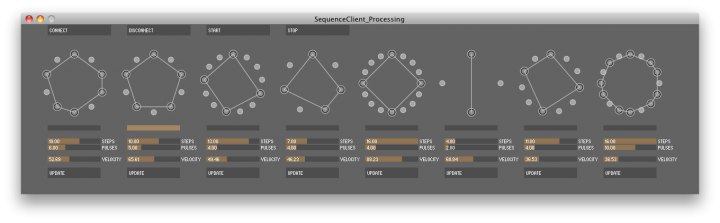
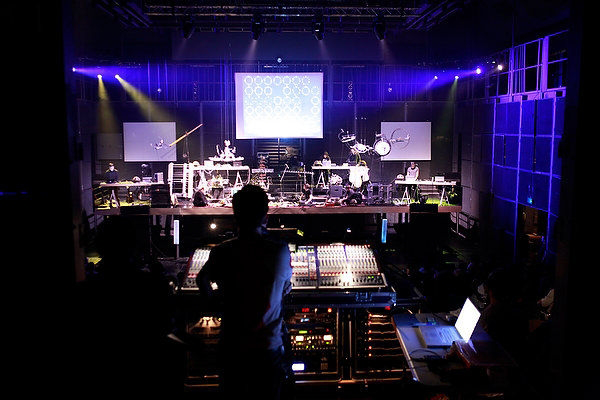
As a piece, Sequence was a structured improv for six human performers and 48 actuators of the Machine Orchestra. The 2011 premiere was performed by me, Perry R. Cook, Jim Murphy, Mo Zareei, Colin Honigman, and Owen Vallis. Each of the performers utilized a custom Processing client to control the actuators, while the visuals and timing sequences were handled by a server using software written in C++/openFrameworks.
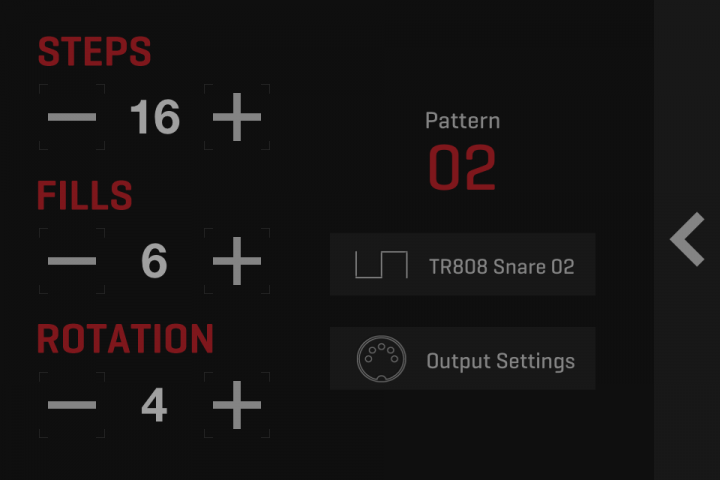
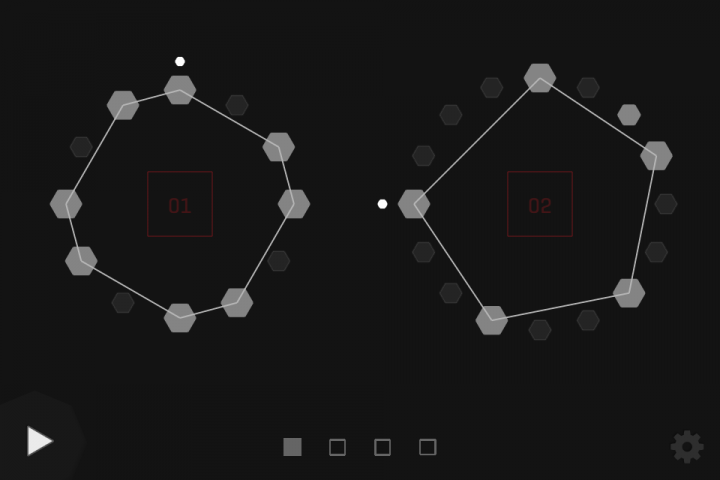
The forthcoming iOS app version can be used in one of three primary contexts. For performance and composition, the app outputs live sequences as OSC and CoreMIDI. Casual users can use built-in drum samples to compose and record entire pieces. Another mode in development is for education: it can be used as an ear training game to derive the right rhythm. As noted in the screenshots, the easiest way of representing these patterns is circularly, with polygons formed by attaching vertices to active pulses.

As a research topic, the piece version of Sequence was an experiment in synchronous musical collaboration through an algorithmic music space. The use of projected visuals was also used to validate methods of familiarizing an audience with actions of the performers in the absence of the gestural cues of traditional instruments. Similarly, the GUI lacked tightly-timed animations, putting notions about computer musicianship to the test as performers had to rely on their instinctive group playing ability in order to maintain cohesiveness.

[1] Godfried T. Toussaint, "The Euclidean algorithm generates traditional musical rhythms," Proceedings of BRIDGES: Mathematical Connections in Art, Music, and Science, Banff, Alberta, Canada, July 31 to August 3, 2005, pp. 47-56.