Netpixl, short for Networked Pixel, is an open-source software framework for building collaborative interfaces. Netpixl is a significant part of my Master’s thesis at CalArts which explores ideas about creative synchronicity on local and wide-area networks. Although Netpixl is being developed as a separate entity, it is a critical part of the social interaction that occurs as part of my forthcoming installation, GR1D (2011/2012).
Netpixl is the spiritual descendant of Argos (2010), an interface builder for large-scale multi-touch surfaces. Since most of the Argos code was tied to surfaces, I abandoned it on account of the difficulties in adapting it to mobile interaction paradigms. A short time later, in researching implementation technology for Signal (2010+) (a distantly related cousin for networked robotic musicianship), I became aware of the real-time capabilities of Socket.io and Node.js, two technologies which can power synchronous communication in modern web browsers. With this combination in hand, I began refactoring the notion of distributed collaborative interfaces for artistic expression into Netpixl.
Netpixl can be used in a variety of ways. Netpixl is a front-end for applications that either expose networked APIs or talk OSC/MIDI. Netpixl can also be built into Javascript applications as the view/GUI layer. Netpixl is smart in that it is scriptable, meaning complex widget behavior can be achieved with little back-end coding. Although Netpixl was designed to run in the browser, it can be wrapped in a platform-specific container (iOS, for instance) to integrate that platform’s sensor capabilities. This interface/sensor combination was a particular ambition because it helps users move out of the ‘pictures under glass’ paradigm that plagues many mobile interfaces.
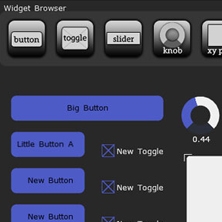
The interface building mode is designed for drag and drop editing in the browser. One or more users can simultaneously work on an interface and map parameters to a working application or installation. These interfaces can then be published to a local or remote Netpixl server. Once published, multiple users can simultaneously use the same interface as it were a social gathering for collaborative artmaking.
Netpixl will be fully open-sourced at the time of publication of my master’s thesis in April 2012.